
How many restrooms does a race in Irvine actually need?
Start with the crowd, not the course. A road race with 2,000 registered runners plus spectators behaves differently than a trail run with 300 people spread over three hours. OSHA 1926.51(c) sets construction-site ratios, but race directors generally lean on that same one-per-20-to-40-person logic when a health department or venue asks for a number, then adjust up for spectator zones, family areas and the finish line chute where lines bottleneck hardest. Portable toilet rental at the start corral should be heavier than mid-course, because that is where nervous energy and pre-race coffee collide in the same twenty minutes.
Mid-course, aid stations along the route typically get one or two standard porta potty rental units each, spaced so runners never lose more than a few minutes to a line. If your race draws a wheelchair division or has registered participants with mobility needs, ADA Standards section 213.2 requires that at least 5 percent of any cluster of single-user units be accessible, with never fewer than one. Irvine Porta Pros stocks ADA accessible porta potty units built to that standard, with a 60 inch turning circle inside per ADA Standards 304.3.1 and a 32 inch clear door opening under ADA Standards 404.2.3. For a full breakdown by expected headcount, the how many porta potties do I need guide walks through the math step by step, and our event restroom rental page covers layout planning for races, festivals and everything sized in between.
What does it cost to rent restrooms for a race in Irvine?
Pricing runs by unit type and by how long the units sit on site, from a single Saturday morning 5K to a weekend festival with a Sunday marathon attached.
| Unit | Weekend | Week |
|---|---|---|
| Standard portable toilet | $125 to $400 | $130 to $500 |
| ADA accessible unit | $199 to $300 | n/a, quote by day |
| Deluxe flushable unit | n/a, quote by day | $150 to $290 |
A standard unit measures about 44 by 48 inches on the ground and stands roughly 92 inches tall, which matters when you are mapping placement near a start line arch or a narrow park path. Delivery fees for a weekend event generally land between $125 and $540 depending on how many drop points your course requires. Races that want something nicer for VIP runners or sponsors often add a deluxe flushable porta potty near the finish festival area. Our porta potty rental cost page breaks down day, week and month pricing in more detail, and the porta potty rental per day page is useful if your event is a single-day sprint rather than a full weekend build.
Where do restrooms and support equipment go on race day?
Placement follows the course map, the aid stations and whatever your timing company sets up for lighting and power. A race that starts before sunrise needs a light tower rental at the staging area, and any timing tent, PA system or food vendor running electric equipment usually needs a temporary power pole rather than a tangle of extension cords across a public path. If you are bracing a temporary power pole on grass or gravel rather than pavement, use a base plate rated for the pole height and guy it at two points roughly 90 degrees apart so wind and foot traffic near the timing tent do not tip it; check the base weekly since Irvine's coastal gusts can loosen an unguyed pole over a multi-day event, and knowing how to brace a temporary power pole properly before race morning saves a scramble when the timing tent goes up in the dark. GFCI protection on any temporary circuit follows OSHA 1926.404(b)(1)(ii), which matters when generators and extension cords are running near restroom trailers and misting stations in the same footprint.
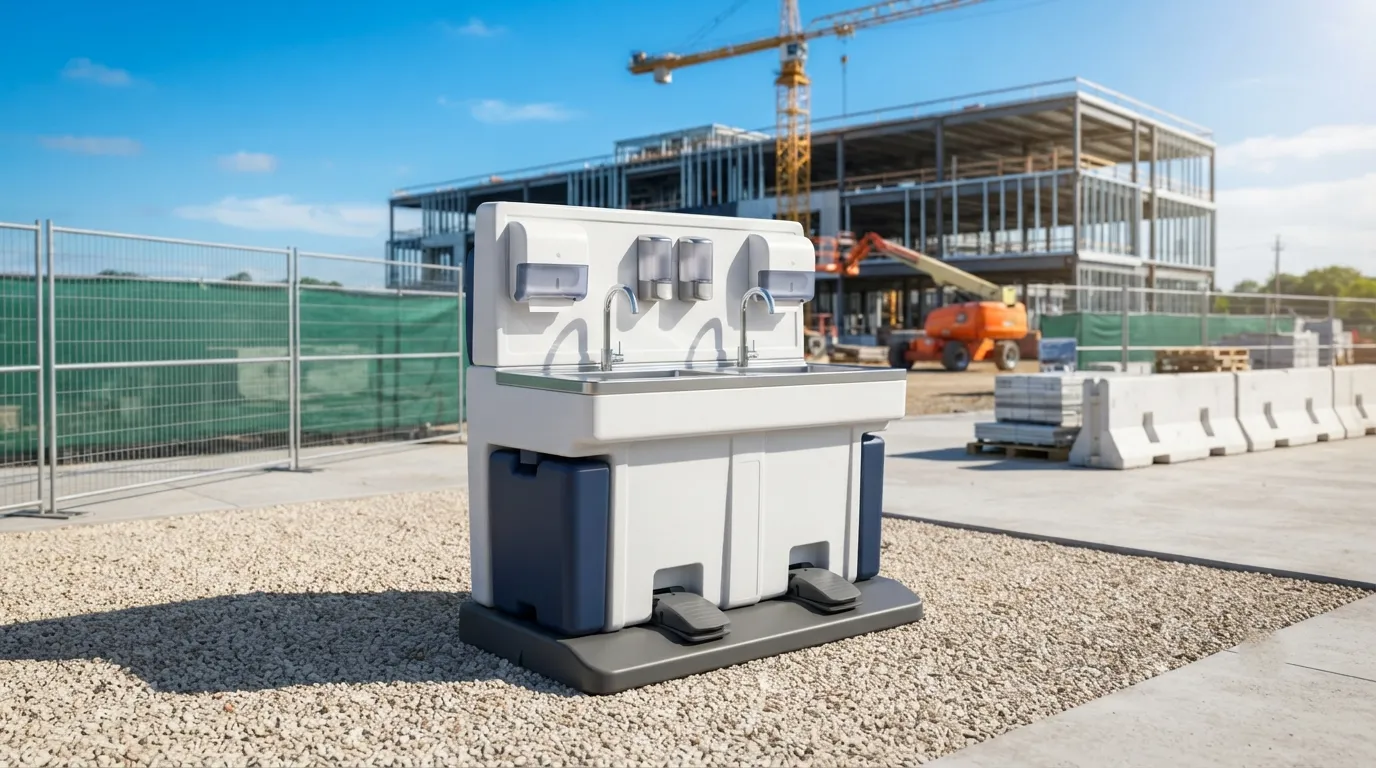
For events larger than a 5K loop, a restroom trailer rental at the finish festival gives runners and families a nicer option than a bank of standard units, and a 2 stall restroom trailer or 4 stall restroom trailer handles most mid-size Irvine races well. Crowd flow near the finish chute often calls for crowd control barrier rental or a stretch of temporary fence rental to keep spectators off the course. Handwashing matters too: 29 CFR 1910.141(d)(2) requires soap and towels or a hand-drying device at wash stations, not sanitizer alone, so a handwashing station rental belongs at every food and medical tent. If your course runs near Laguna Woods, 5.6 miles southeast, or extends toward Laguna Hills, 8.5 miles southeast, delivery routing and drop times should be confirmed early since multi-point courses take longer to service than a single festival footprint.
How far in advance should I book restrooms for a race?
Book six to eight weeks out for anything over 500 runners, longer if your date falls on a busy fall weekend. Irvine race calendars fill up delivery slots fast, and multi-point courses need more trucks scheduled than a single-location festival.
Do we need ADA units even if no wheelchair racers are registered?
Yes. ADA Standards 213.2 requires accessible units in any cluster regardless of registration, since spectators, volunteers and staff also need access. One accessible unit minimum, more as your total unit count grows.
Can restrooms be moved along the course during a rolling event?
Units generally get placed before the race and serviced afterward rather than moved mid-event, since foot traffic makes relocation impractical. For a rolling start with staggered corrals, we place separate clusters instead of shifting one bank of units.
What is the difference between a portable toilet and a restroom trailer for a race?
A standard unit is a single stall with a holding tank; a trailer has multiple stalls, sinks and often climate control. Trailers cost more but suit finish-line festivals better. See portable restroom rental for the full comparison.
Who handles permits for restrooms placed in a public right of way for a race?
Placement in the public right of way needs confirming with the City of Irvine directly, since permit rules vary by course and by street closure plan. Check our porta potty permit requirements guide before finalizing your layout.
Next step
Get a delivery date
Tell us the address, the dates and the headcount. We size the order and confirm the route.